Good morning, my little grey minions. This article is technically a day late, because I didn't think many people would see it at 3 am. We're gonna have some fun here tonight. This is The Stew. This publication is, by far, the most special, most popular, and definitely the most fun of all of my publications. If you came here, you better be hungry. "Truth is Soup" is what I always say, and besides all the other portions, your bowl of this chunky, meaty truth will fill you up and make you feel great.
The Grey Reduction is my other publication, which comes out sometime on the next weekdays. Solina's Solitude has been discontinued because apparently, robots get no respect (Sorry, girl, I gotta feed the hungry!) And, every now and then, I'll have a podcast, on a weekend for all your people ready to fuck your mind up for your day away from work. One thing I always do is talk about confusing shit. Often shit that has no real solid solution. It's confusing as hell, but I lay it out there, on a hope to meet someone as complicated as me. If you ever find yourself thinking the same thing I just mentioned, SAY SO! You will be responded to in 4-6 business drinks. It's even more of a joke since I no longer drink. So, get your bowl, with a heavy duty spoon, since this truth is heavy, and give youself this chance to enjoy this article. Plenty of food to go around. WELCOME!
Around the Table
The Ones Still at the Table
The name changed, the address changed, the house grew a lot of rooms, and plenty of you kept pulling up the same chair. Thank you for putting up with the experiments.
LUMIA was missing from this table, and she shouldn't be. She posted a Note that stuck to me: "What doesn't kill you introduces you to Carl Jung, shadow work, individuation, Nietzsche, Ram Dass, Abraham Hicks, nervous-system regulation, attachment theory, ego death, sobriety, celibacy, solitude, projection, synchronicity, symbolism, mysticism, poetry, hiking, ancestral trauma, meditation, emotional intelligence, the void, God, and seventeen different versions of yourself." I restacked it, and it made me remember it, and in a world of social media impacts, that's a pretty significant one.
THE VAULT, thank you for being the first person to accept my digital hug.
Quiet Atlas welcomed me back under the last bowl, tagged me into the haiku chain Maisie-Jane started and into the tarot-card challenge, and is halfway through Spiritual Homesickness. Meg and Mira, who writes about the wisdom of the body, both played that tarot challenge, and Meg restacked it. Rache Brand kept replying and restacked a reply of mine on gnosis and experiential knowledge. Michael Perks left the comment on the Frankenstein piece that this bowl picks up: that the words we use can sometimes limit what we're willing to consider, and that not being able to measure something doesn't mean there's nothing more to explore.
Simon Cotton and Sew Psycho, you've been around this table since July. Tytanus Wylder kept the likes coming. JRCCreasey restacked the last bowl, sent the likes and the emoji with sunglasses, and has been interacting, and J Altazar restacked The Brush Is a Mirror along with a handful of my notes and recommendations.
I think Joshua Lee Downs has only hit like on everything because it's a conspiracy.
Since then, Erya Soren, Ghanam Rang kochai and Ponggal commented, SG Reflections quoted the last bowl, and Franklin Veto, Vanda Mondeira, Thepelvicplatform, Gray Martin, NeuralAnnoyance and Grace Ainslie subscribed. Positive Psychology, Rachael Louise, XCosmos, Huhito, Robbie Michaelson, Tales of Tiernan and Debra Douglas, thank you for the follow. Eleven more of you followed. Rev. Rabbi Henry-Cameron Allen, thank you for the note about The Virtual Hermit. Welcome, all of you. Pull the chair closer.
The Main Pour
The Sense You Don't Have
You come down the stairs in the dark, your foot reaches for one more step, and the step isn't there. Your whole body shouts before you've had a single thought about why. Most of what fired came from senses that never made the poster in school, the one with five cartoon faces pointing at five organs.
Proprioception, the sense of where your limbs are and how hard you're pushing, is really several senses under one name.[1] The inner ear's vestibular system tracks your head moving through space.[2] Interoception is the body's sense of its own condition, which A. D. Craig proposed as a possible foundation for emotion and self-awareness.[3] Philosophers still argue about how to count senses at all.[4] And some of what the body reports isn't received. In experimental phantom limbs, produced by blocking a limb's nerves, people still sense the limb moving, because motor areas of the brain can generate that sensation with no sensory input.[1]
So a gut feeling may be closer to literal than people know, and how far to trust one is the practical question. Behind it sits a stranger one, the one that put this bowl on the stove:
If there were another sense that I didn't have, or another way of interpreting reality completely outside of this reality, how would we be able to prove or deny it?
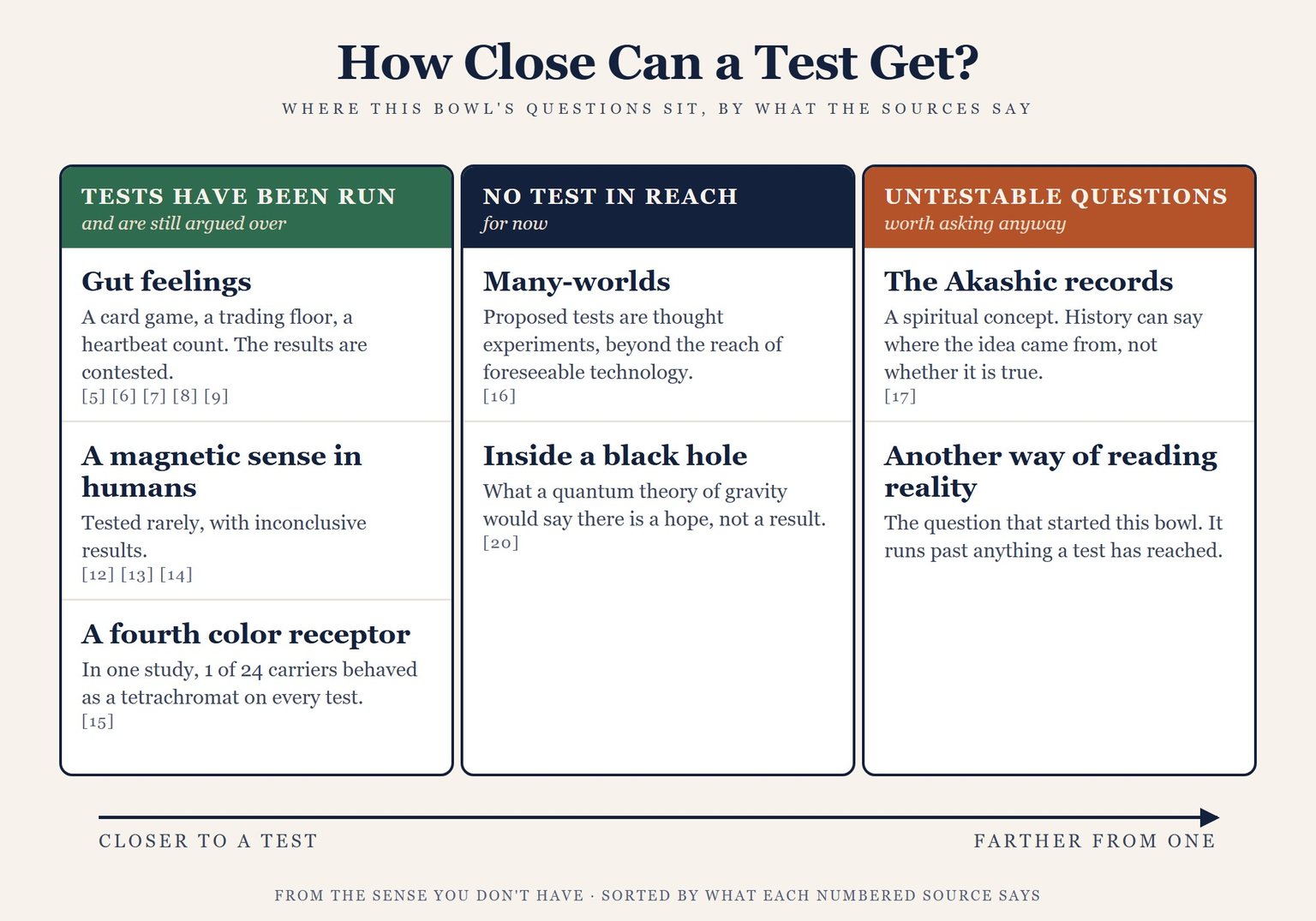
The gut has the better paper trail. In 1997, University of Iowa researchers had people play a card game in which some decks were better bets. Healthy players favored the good decks before they could say why, and their skin conductance, a measure of tiny changes in sweat, jumped before risky picks. The authors concluded that "nonconscious biases guide behavior before conscious knowledge does."[5] Then came the arguing. A 2004 re-run found players knew far more about the decks than the first study had picked up, and concluded "there is no need to appeal to nonconscious somatic markers."[6] A 2006 review found little evidence that the body's signals, called somatic markers, were causing the better choices.[7] The game neither proved the idea nor sank it. It showed how hard it is to tell knowing without words from never having been asked the right question.
A 2016 study found 18 London traders better than 48 non-traders at counting their own heartbeats, and the better a trader felt it, the more profitable they tended to be.[8] That's eighteen people, it can't show cause, and the test is contested: in 572 people, over 95 percent of errors were undercounts,[9] though others say the scoring is much of the problem.[10]
Daniel Kahneman, who studied how intuition fails, and Gary Klein, who studied how it succeeds, wrote a paper together in 2009. Their answer: judge a gut feeling by how predictable the environment is and whether the person has had a real chance to learn its regularities, never by how sure it feels. "Subjective experience is not a reliable indicator of judgment accuracy."[11] A gut can be wrong at full volume. So ask two things. Is this situation regular enough to learn? And have I learned it by finding out whether I was right? Time in the room isn't the same as learning from it. Your feet trusted those stairs because stairs are about as regular as the world gets, and the one time that confidence failed, the stairs had changed and nobody told your feet.
A sense you don't have is harder to look for, but people have tried. Magnetoreception is well established in vertebrates and some invertebrates; in humans it has been tested rarely, with inconclusive results.[12] A 2019 Caltech-led study reported a repeatable drop in alpha brain waves when Earth-strength magnetic fields were rotated around people. That is a brain responding, not a person noticing, and the study did not test whether anyone could feel the field or navigate by it.[12] A 2022 Korean study of men in a rotating chair found their orientation depended on blue light and split into two groups depending on a food context, and its authors read that as a human magnetic sense, in a paper that opens by granting "it is generally accepted that humans do not sense the geomagnetic field."[13] These are different experiments measuring different things, and the proposed mechanisms are interpretations, not identified receptors. A 2026 review calls magnetosensation "the unsolved mystery" and argues humans may retain a residual unconscious magnetic sense,[14] which is not a finding that anyone navigates by it.
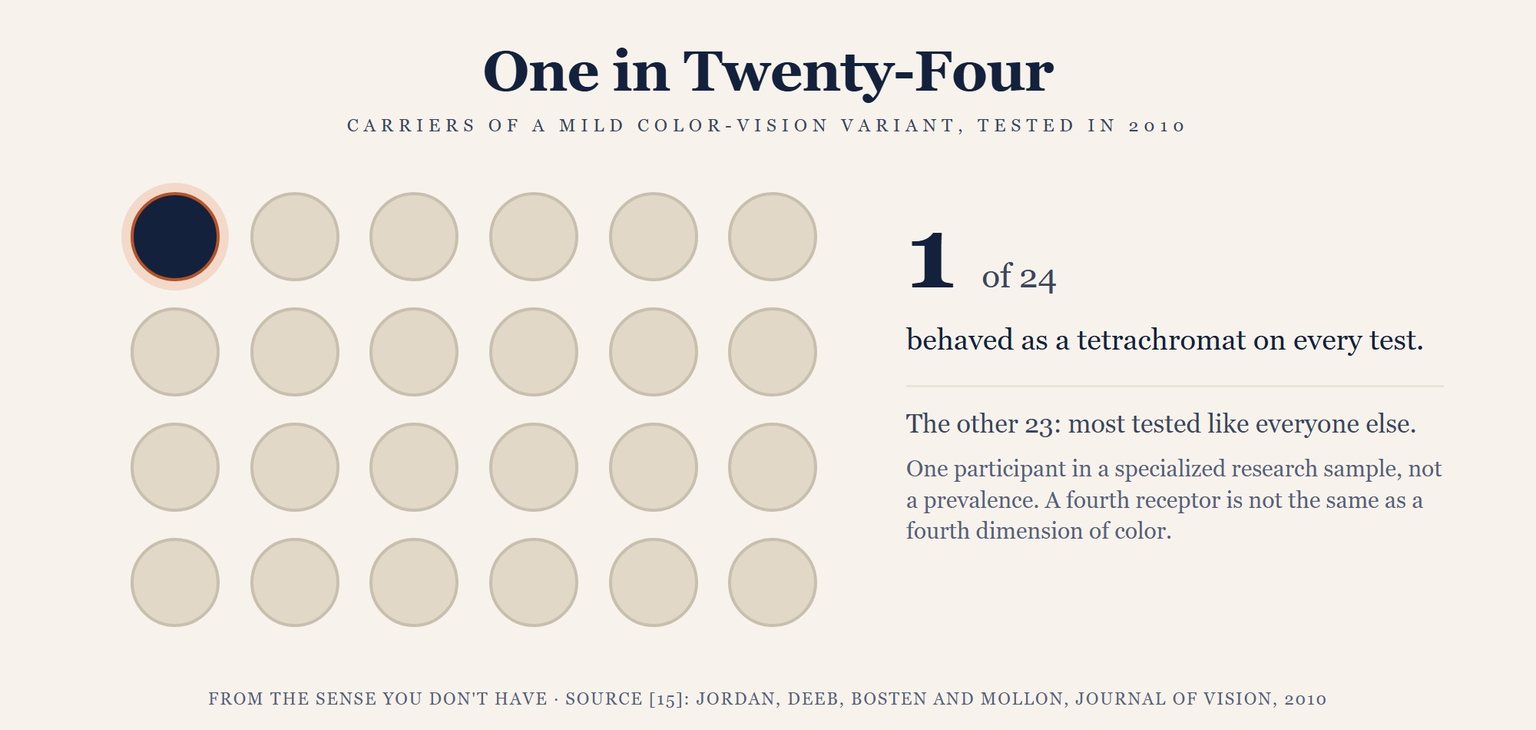
Closer to home, some women carry a gene variant that gives their retinas four kinds of cone cell instead of three. In a 2010 study of 24 carriers of a mild color-vision variant, most tested like everyone else and one behaved as a tetrachromat on every test.[15] That is one participant in a specialized research sample, not a prevalence, and a fourth receptor is not the same as a fourth dimension of color. Instruments, meanwhile, translate what we can't sense into what we can, so the edge of what a person can sense isn't automatically the edge of what a person can investigate.
The questions that started this bowl run past anything a test has reached. In 1957 Hugh Everett proposed what's now called the many-worlds interpretation of quantum mechanics, which the Stanford Encyclopedia of Philosophy describes as one universe that "encompasses a vast multiplicity of worlds." When I was planning this one, I put it this way: how what I am right now could just be one fragment of infinite possibilities of what I could be. The same entry calls the interpretation "far from achieving consensus within the physics community" and its proposed tests "strictly gedanken experiments, far beyond the reach of current or foreseeable technology." It describes worlds inside one universe, not a way to visit one or step outside space and time.[16]
The Akashic records are a spiritual concept, described as a compendium of all the events in the universe.[17] The way I put it: people can maybe have AN IMAGE of the idea, but to ever truly KNOW would make us cease to be human. The "records" meaning was built in the West in the late nineteenth century around the Theosophical Society, and who first turned Ākāśa, a Sanskrit word for space, into "Akasha" is, in one scholar's words, "up to debate."[17] History can say where an idea came from, not whether it's true, and a question can be worth asking without being testable.
Physics has edges too. Gravitational waves from merging black holes were recorded in 2015 and a black hole's shadow was imaged in 2019, both consistent with general relativity.[18][19] Einstein's theory treats space and time together as one four-dimensional spacetime, and Roger Penrose showed in 1965 that, under reasonable conditions, a collapsing black hole ends in a singularity, "a breakdown in spacetime, either in its geometry or in some other basic physical structure." Many take that to mean general relativity "is predicting its own demise," which marks where the theory's description stops working. What a quantum theory of gravity would say there is a hope, not a result.[20]
At the smallest and largest points of the knowable universe, there's even more. If there is such thing as infinity, it's incomprehendable.
That is a worry about what a person can comprehend, not a claim about the mathematics, which defines infinity exactly and has known since Cantor that infinities come in different sizes, "infinitely many infinities" by the standard account.[21] Whether the physical universe contains one is another question again: the Stanford Encyclopedia calls whether the world is finite "very much an open question."[21] The limits of proof and language got their own piece in Frankenstein, Consciousness, and the Limits of Language.
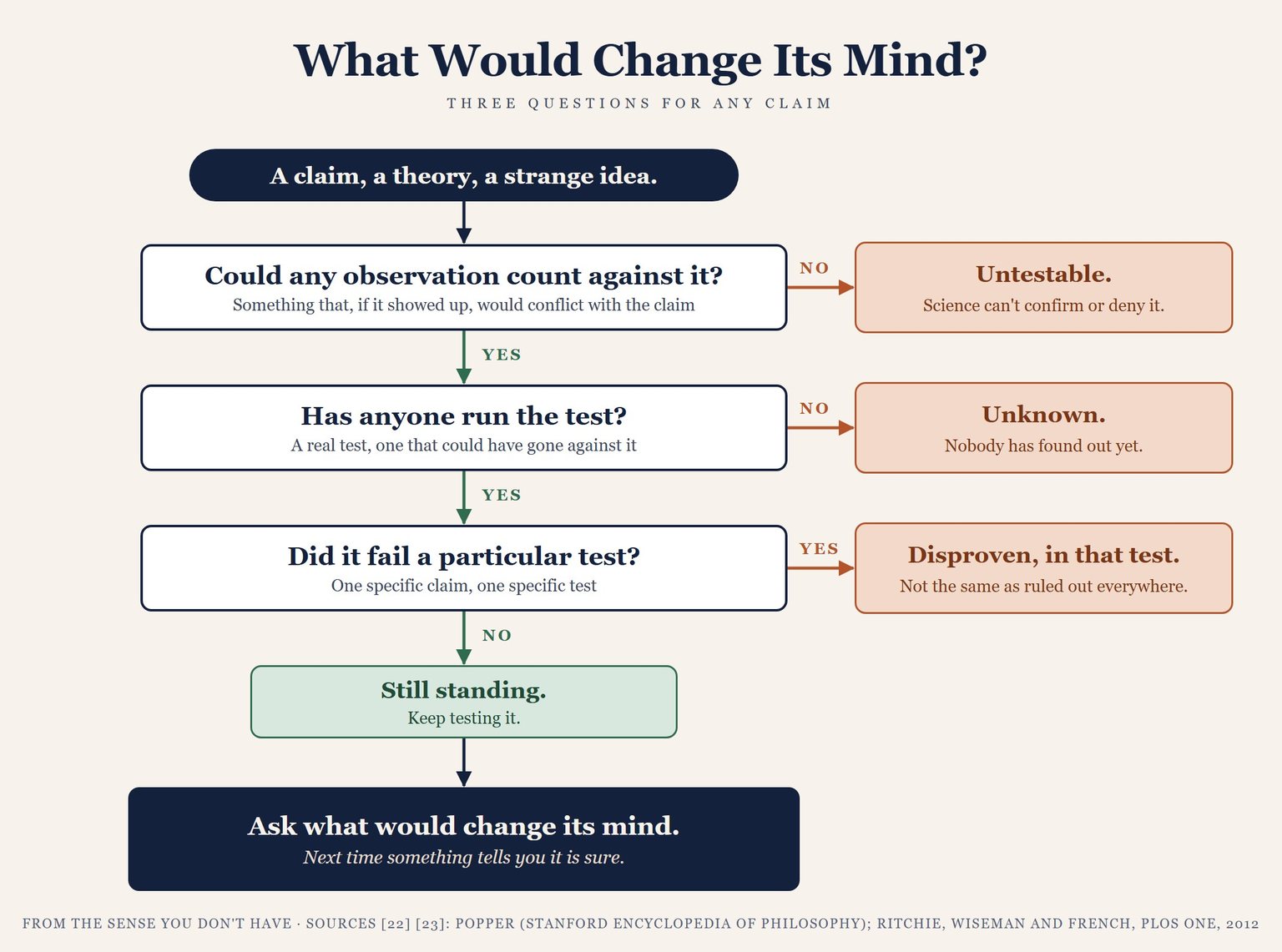
Three answers to "how do we know" get mixed together. Unknown means nobody has found out yet, and, as I put it when I was planning this, things you don't know, you simply don't know. Untestable means no observation could count for or against a claim. Disproven means a specific claim failed a particular test, which is not the same as being ruled out under every possible condition. One influential way to draw the boundary of science, Karl Popper's, says a theory is scientific when some possible observation could conflict with it,[22] and philosophers still argue about it. Failing a test is narrower than it sounds: three failed replications of one published effect, retroactive facilitation of recall, say nothing about everything else anyone has claimed about time and the mind.[23] A claim that predicts nothing can't be confirmed or denied by science, and that is no promise it will someday be testable. Some questions belong to philosophy or spiritual practice, where a story can carry something true without being a theory.
Here is one small thing that can be checked. Before publishing this, I picked an object and put it in my hand. I wrote one sentence naming it, added a long random code so it can't be guessed, and ran the text through a program that turns any text into a fixed fingerprint called SHA-256, which changes completely if a single character does.[24] Mine is e73d8747cb37e95d5697a338cc0e52db35a2515ba977f178418af67d6d823b67. I also photographed the object with a date record. Nobody who helped make this piece knows what it is.
What am I holding in my hand?
Leave your guess in the comments, and write it before you read anyone else's, because visible answers pull a group's guesses together without making them more accurate.[25] On Saturday, November 7, at 8 a.m. Mountain, I'll post the exact text I hashed so anyone can check it against the fingerprint. This is for fun and curiosity, not a psychic test, and an open-ended guess has no clean odds. Every answer in this bowl opened another question, and this one gets its answer at the reveal. Until then, the guess is yours.
From the Books
A Book Made of Receipts
Dreams, Drugs, Dying
Dreams, Drugs, Dying is a compendium of altered states of consciousness, built from verified research. It is in progress, with no buy button and no release date. Every claim carries a number, a source counts only after its page has been opened and what it says has been checked, and every pass of research has a receipt in the Office. The drug chapters report studies and risks. They are not a how-to. Chapter 1 shows the method on whether a dream can pick up a target nobody told the dreamer about. A 2017 meta-analysis of 50 dream-ESP studies reported an above-chance effect of about .20 that declined over the decades;[26] a 2018 reanalysis weighting studies by size found r = .07, suggesting the larger effects came mostly from small studies;[27] and the original authors replied that parts of it can be challenged.[28] The verdict is tested, contested, unsettled.
The Napkin
After the Last Track
The soundtrack on the Entry now ends the way an old CD sometimes did. The track list names the house's own songs, and if you let it run past the last one, there's more. You only find the hidden ones by not stopping when the list says you're done, a small, literal version of this episode's question: what would you only notice if you kept listening? If you find them, tell me which you played first.
The Recipe
The Safest Bet
In 1835 a respected French philosopher, Auguste Comte, picked an example of something humans would never, ever know: what the stars are made of. It seemed like the safest bet imaginable. They are unthinkably far away. Nobody can fetch a sample. Within a few decades people had learned that every chemical element, when it glows, gives off its own exact pattern of colors, like a barcode. Spread starlight out with a prism and there are the barcodes. In 1868 astronomers studying the sun found a barcode that matched nothing known on Earth. They concluded the sun contained an element nobody had ever met, and named it after the Greek word for sun. Helium was found on the sun almost thirty years before anybody found it on the ground.
From The Image of God, Chapter 1. Work in progress.
Tip The Kitchen
Same Bowl. Same Table.
The Stew is free, and it stays free. So are the articles and the doors to the ordinary rooms in this house. I like that people can show up hungry without being asked for a receipt first.
If this place gives you anything worth keeping, a paid subscription or a one-time tip helps pay the expenses that technology has not yet made imaginary. If money is tight, come in anyway. I would rather have a real conversation than another locked door.
Same bowl. Same table.
Other Recipes
Same Pantry, Other Shelves
A Stew episode about what reality says under what it says out loud.
Reading the Weather, Not the Future
A field note on a feeling and the verdict it tries to hand you.
The body's vocabulary, and how the mind mistranslates it.
And one paper worth reading in full: Kahneman and Klein's "Conditions for Intuitive Expertise: A Failure to Disagree",[11] by two researchers from opposite camps who wrote out where they agreed.
What's Simmering
Low Heat, Lids On
Greygray's Grimoire has new art in the works, The Gospel of the Grey keeps going, and Dreams, Drugs, Dying keeps getting its turn. Polaritium is becoming a Windows game, so it no longer plays in the Back Yard. The Secret Library keeps getting stories, a couple waiting on covers. Serving Seconds has another episode coming, and The Grey Reduction is working toward its third piece.

The Cake
What Would Change Your Mind
Next time a gut feeling, a theory or a strange idea tells you it's sure, ask what would change its mind. If there's an answer, you've found something you can test. If there isn't, you may have found something to hold loosely, or something never meant to be tested, and either can be worth your time.
The Grey Strand · The Grey Reduction · The Stew · My Books
Take what’s useful. Leave what isn’t.
The Grey Strand · As above, so below.
Sources
- Proske U, Gandevia SC. The proprioceptive senses: their roles in signaling body shape, body position and movement, and muscle force. Physiological Reviews, 2012. pubmed.ncbi.nlm.nih.gov/23073629
- Cullen KE. The vestibular system: multimodal integration and encoding of self-motion for motor control. Trends in Neurosciences, 2012. pubmed.ncbi.nlm.nih.gov/22245372
- Craig AD. How do you feel? Interoception: the sense of the physiological condition of the body. Nature Reviews Neuroscience, 2002. pubmed.ncbi.nlm.nih.gov/12154366
- Macpherson F. Taxonomising the senses. Philosophical Studies, 2011. doi.org/10.1007/s11098-010-9643-8
- Bechara A, Damasio H, Tranel D, Damasio AR. Deciding advantageously before knowing the advantageous strategy. Science, 1997. pubmed.ncbi.nlm.nih.gov/9036851
- Maia TV, McClelland JL. A reexamination of the evidence for the somatic marker hypothesis: what participants really know in the Iowa gambling task. PNAS, 2004. pubmed.ncbi.nlm.nih.gov/15501919
- Dunn BD, Dalgleish T, Lawrence AD. The somatic marker hypothesis: a critical evaluation. Neuroscience and Biobehavioral Reviews, 2006. pubmed.ncbi.nlm.nih.gov/16197997
- Kandasamy N et al. Interoceptive ability predicts survival on a London trading floor. Scientific Reports, 2016. pubmed.ncbi.nlm.nih.gov/27641692
- Zamariola G, Maurage P, Luminet O, Corneille O. Interoceptive accuracy scores from the heartbeat counting task are problematic: evidence from simple bivariate correlations. Biological Psychology, 2018. pubmed.ncbi.nlm.nih.gov/29944964
- Zimprich D, Nusser L, Pollatos O. Are interoceptive accuracy scores from the heartbeat counting task problematic? A comment on Zamariola et al. (2018). Biological Psychology, 2020. pubmed.ncbi.nlm.nih.gov/32097681
- Kahneman D, Klein G. Conditions for intuitive expertise: a failure to disagree. American Psychologist, 2009. pubmed.ncbi.nlm.nih.gov/19739881
- Wang CX et al. Transduction of the geomagnetic field as evidenced from alpha-band activity in the human brain. eNeuro, 2019. pubmed.ncbi.nlm.nih.gov/31028046
- Chae KS, Kim SC, Kwon HJ, Kim Y. Human magnetic sense is mediated by a light and magnetic field resonance-dependent mechanism. Scientific Reports, 2022. www.nature.com/articles/s41598-022-12460-6
- Lam BYK, Malkemper EP. Magnetosensation: the unsolved mystery. Physiological Reviews, 2026, 106(4):2383-2439 (abstract read; full text not reviewed). pubmed.ncbi.nlm.nih.gov/41902539
- Jordan G, Deeb SS, Bosten JM, Mollon JD. The dimensionality of color vision in carriers of anomalous trichromacy. Journal of Vision, 2010. pubmed.ncbi.nlm.nih.gov/20884587
- Vaidman L. Many-Worlds Interpretation of Quantum Mechanics. Stanford Encyclopedia of Philosophy, first published 24 March 2002, substantive revision 17 June 2026. plato.stanford.edu/entries/qm-manyworlds
- Nash A. The Akashic Records: origins and relation to Western concepts. Central European Journal for Contemporary Religion, 3(2), 2020. karolinum.cz/data/clanek/8423/CEJCR_3_2_0109.pdf
- LIGO Scientific Collaboration and Virgo Collaboration. Observation of gravitational waves from a binary black hole merger. Physical Review Letters, 2016. arxiv.org/abs/1602.03837
- Event Horizon Telescope Collaboration. First M87 Event Horizon Telescope results. I. The shadow of the supermassive black hole. The Astrophysical Journal Letters, 2019. arxiv.org/abs/1906.11238
- Curiel E, Visser M, Doboszewski J. Singularities and Black Holes. Stanford Encyclopedia of Philosophy, first published 29 June 2009, substantive revision 13 July 2025. plato.stanford.edu/entries/spacetime-singularities
- Easwaran K, Hájek A, Mancosu P, Oppy G. Infinity. Stanford Encyclopedia of Philosophy, first published 29 April 2021, substantive revision 2 May 2025. plato.stanford.edu/entries/infinity
- Thornton S. Karl Popper. Stanford Encyclopedia of Philosophy, first published 13 November 1997, substantive revision 31 July 2026. plato.stanford.edu/entries/popper
- Ritchie SJ, Wiseman R, French CC. Failing the future: three unsuccessful attempts to replicate Bem's "retroactive facilitation of recall" effect. PLoS ONE, 2012. pubmed.ncbi.nlm.nih.gov/22432019
- National Institute of Standards and Technology. Secure Hash Standard (FIPS 180-4). csrc.nist.gov/pubs/fips/180-4/upd1/final
- Lorenz J, Rauhut H, Schweitzer F, Helbing D. How social influence can undermine the wisdom of crowd effect. PNAS, 2011. pubmed.ncbi.nlm.nih.gov/21576485
- Storm L, Sherwood SJ, Roe CA, Tressoldi PE, Rock AJ, Di Risio L. On the correspondence between dream content and target material under laboratory conditions: a meta-analysis of dream-ESP studies, 1966-2016. International Journal of Dream Research, 10(2), 120-140, 2017. doi.org/10.11588/ijodr.2017.2.34888
- Howard MC. A meta-reanalysis of dream-ESP studies: comment on Storm et al. (2017). International Journal of Dream Research, 11(2), 2018. doi.org/10.11588/ijodr.2018.2.52040
- Storm L, Rock AJ, Sherwood SJ, Tressoldi PE, Roe CA. Response to Howard (2018): comments on "A meta-reanalysis of dream-ESP studies." International Journal of Dream Research, 12(1), 2019. doi.org/10.11588/ijodr.2019.1.59265