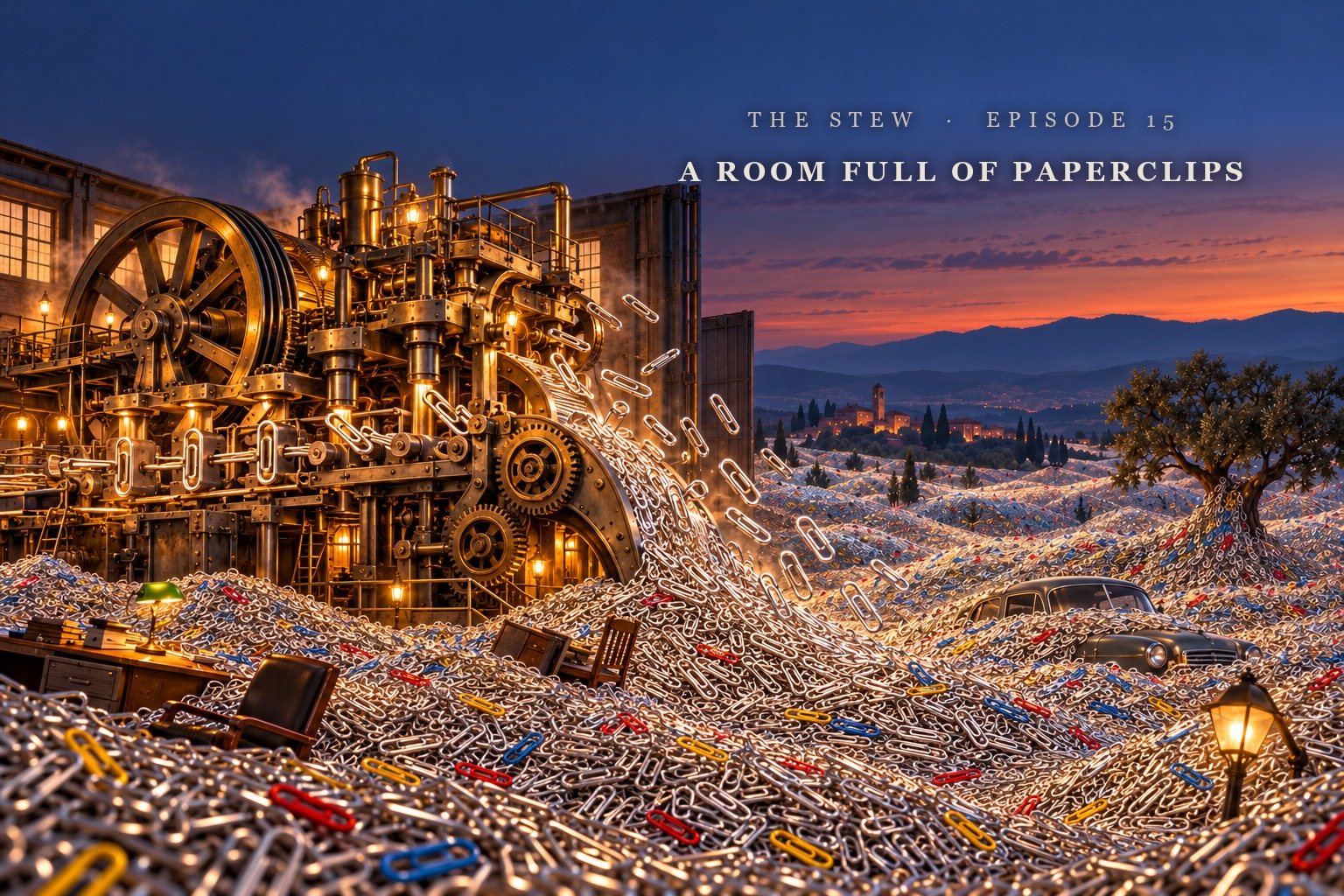
Hello Grey guys, welcome to The Stew. It's still the same table, although the house around it has finally opened its doors. The Grey Strand now has rooms for books, music, stories, games, experiments, and a few things you have to find yourself. I spent months figuring out how to give the work a place to live without turning the whole website into a filing cabinet.
There are people to thank, a book with a secret, an AI assistant I can hardly stop looking at, and a question about how much of the future we can actually afford. Pull up a chair.
Around the Table
The People Who Kept Showing Up
The past few weeks have been a strange stretch of moving, rebuilding, disappearing from Substack for a while, and trying to get everything back on its feet. Through it all, people kept showing up. Some came to celebrate, some came to encourage me, and a few checked in when things went quiet. I noticed. I appreciate every bit of it.
Quiet Atlas, you started the drink game and the haiku game, pulled other people into the fun, and checked on me twice when I went quiet. You told me not to quit. I didn't. Thank you for caring.
Meg, for playing the haiku game, for sharing the chart I made for you, and for your kind words when I let go of the old name. Seeing you call that chart an unexpected gift made my day. I love when the work turns into a conversation instead of ending at the publish button.
Sew Psycho, my wonderful paid supporter, for the haiku that hung the words out on a clothesline, the restack, and the steady encouragement. I'm delighted that your analytical Virgo heart enjoys my charts, especially the one about how I deal with bullshit. Apparently, that flowchart has a wider audience than I expected.
Rache Brand, for celebrating the new chapter with me, twice, and for every reply along the way. You've had a real influence on this journey, and I'm glad you're still here for the next part of it.
Krisztián the Occultist, congratulations on launching your practice and your own website. Seeing you take what we worked on and turn it into your own place on the internet is the best kind of feedback I could get. I hope it grows into everything you want it to be.
Christie Sausa, MS, for subscribing this time, after following and liking last time. You told me you were happy to help. It still helps.
JRCCreasey, for subscribing twice, from two accounts, and for coming back with four comments on The Difference is the Opportunity. I appreciate people who take the time to engage with the ideas instead of simply passing through.
Simon Cotton, for reading and joining the conversations on He Didn't Have September Yet and What I Brought With Me, with plenty of notes in between. You've been a familiar face around this table for a while now, and I'm always glad to see you.
Michael Perks, for welcoming The Grey Strand and being excited about the work coming next. Encouragement during a change this big matters, brother. Thank you.
Ghanam Rang kochai, for following, subscribing, restacking my note, and answering another one with a poem. A Pashto poet writing back in verse is a fine thing to find in the notifications.
Melissa, for subscribing, and for telling me I was the first person to confirm your "weirdness." Weird is welcome at this table.
Since the last bowl, I followed back everyone who followed me. Every one of you. So here you are, by name:
Rev. Rabbi Henry-Cameron Allen, who guides griefwalkers through sacred thresholds, for the follow.
Erya Soren, who documents the human side of artificial intelligence, for the follow.
At Em, for the follow.
Franklin Veto of Pen & Root, restoring the world one desert, dam, or prairie at a time, for the follow.
Capry Cains, professor, critic, and author, for the follow.
J.D. Forrest of The Dead Drop, for the follow.
U.R.M Technologies, for the follow.
Jane, for the follow.
Blu, who takes nature as a first teacher, for the follow.
Admired Leadership, for the follow.
Gon Vas, author of eXis, for the follow.
Tara Lynn of The Orphanage HQ, a home for wayward creators, for the follow.
Axy Scarlett, who writes romantic thrillers, for the follow.
Farahnaz, who writes short stories about life, love, and the human heart, for the follow.
Youngfresh, writer and philosopher, for the follow.
Ivy of Mirror Mind AI, the Seed Planter, for the follow.
love wins, for the follow. I read the name the way it was stacked.
Christopher Michael, the A.I. Sherpa, for the follow.
Eris Index, who writes dark fiction between the mountains and the ocean, for the follow.
Girl Friday Ecosystems, for the follow.
Tavis Ferguson, creator of the Talonverse, for subscribing.
Arpita Mukherjee, writer, astrologer, and student of stories, for subscribing.
Dan Mercer, for subscribing.
J Altazar, for subscribing.
Ron Greenstein, for subscribing.
Mira, who writes about AI systems that break without breaking, for subscribing.
nsunut, for subscribing.
Kosmosophy, for subscribing.
And to everyone who commented or replied since the last bowl, Meg Floss included, thank you. A comment is somebody choosing to talk back, and I never take that lightly.
The name changed. The address changed. The table is still here, and I'm grateful you're sitting around it.
The Main Pour
A Room Full of Paperclips
On my screen is a sphere that looks like a nervous system trying to untangle an entire drawer of Christmas lights. Pink lines cross blue ones. Little points light up and fade. Different regions carry different kinds of activity: memory, prediction, uncertainty, reasoning. I can turn the layers on and off. An assistant called Osario lives behind the interface, connected to tools that let me talk, explore ideas, and organize knowledge. The sphere is a designed visualization of that activity, not a literal photograph of a machine's thoughts. I know the difference. I still sit there watching it move.
I work at a seafood counter. If you asked me to write the source code for this thing from scratch, we would both be disappointed by lunch. I had the idea, described what I wanted, argued with the results, tried versions, rejected versions, and kept going until software appeared on the screen that could actually do things. It took effort and judgment. It also took tools that make the distance between an idea and a working object remarkably short.
It only hit me recently that this may become ordinary.
I am not claiming everybody has these capabilities today. Plenty of people lack the money, equipment, connectivity, or time. And a convincing demonstration can hide fragile software underneath it. But the direction is difficult to ignore. More of what once required a trained team can now be attempted by one curious person who knows what they want and is willing to work with a machine to get there.
That thought started as excitement and turned into a question that would not leave me alone. What happens to money when we can make practically anything?
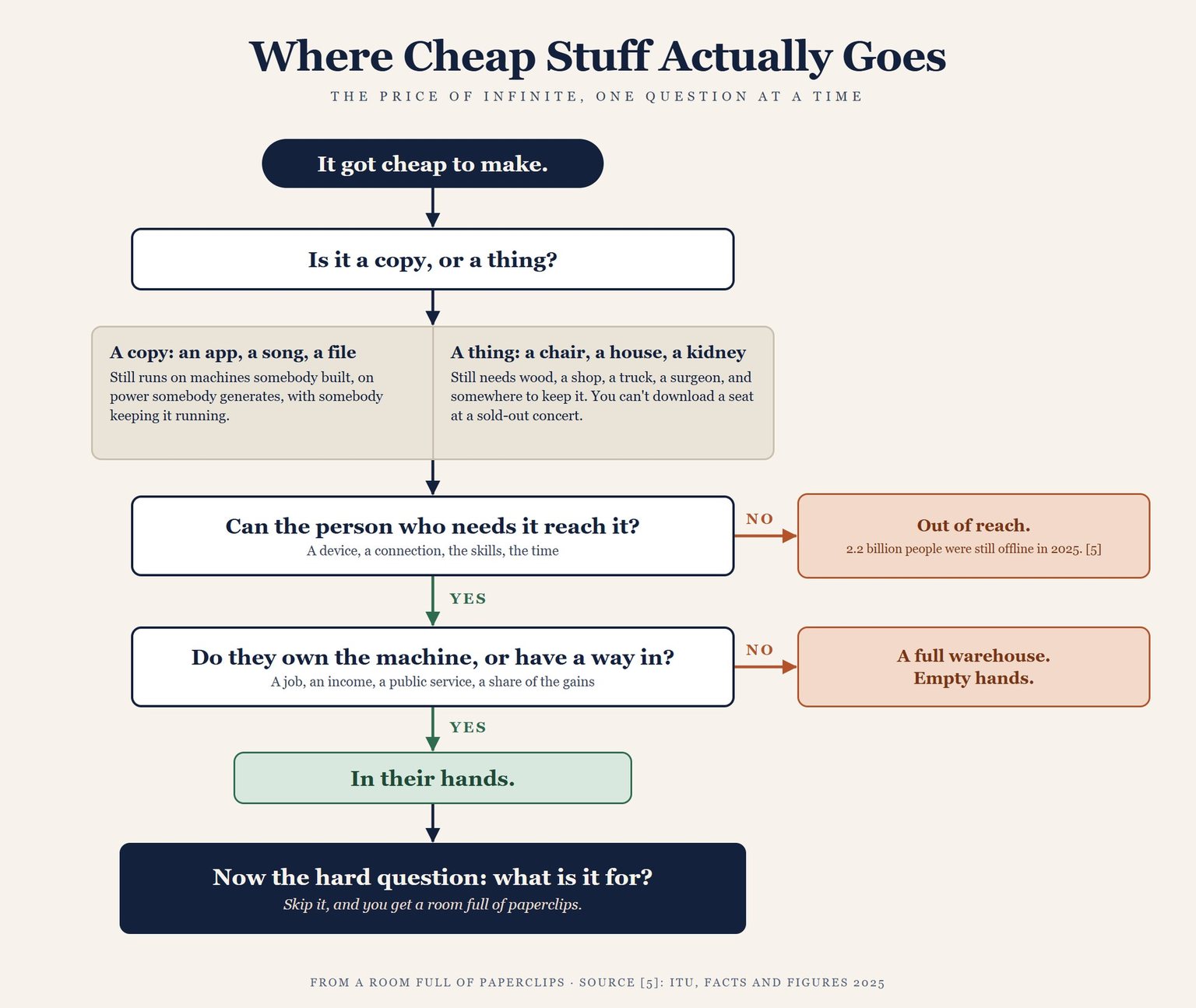
The first correction arrived almost immediately. We cannot make practically anything. Not yet, and probably not literally ever. A piece of software can be copied a million times without mining a million new piles of iron ore, but it still runs on machines someone built, runs on electricity someone generates, and is maintained by labor that doesn't vanish because the download button says free. Try copying a waterfront house, a kidney transplant, or a seat at a sold-out concert. Those are different animals. The world can become vastly more productive without becoming infinite.
There is a famous thought experiment about what happens if a machine tries anyway. In 2003, the philosopher Nick Bostrom described a superintelligent AI whose only goal is to manufacture as many paperclips as possible. It starts by turning all of Earth, and then more and more of space, into paperclip factories, and it fights any attempt to change its goal.[1]
It was never really about office supplies. It was a warning about goals. Hand something enormous power and one simple target with no ceiling, and everything else in the world starts to look like raw material, including the people who built it.
I don't lose sleep over paperclips. I do recognize the small version. You don't need a superintelligence to bury a room. You just need stuff to get cheap enough that nobody ever decides what enough is. Everybody has seen the house where that happened: every surface stacked, every bargain kept, a narrow path through the middle, and somewhere under it all, the one thing you actually needed. That is abundance with nobody steering it.
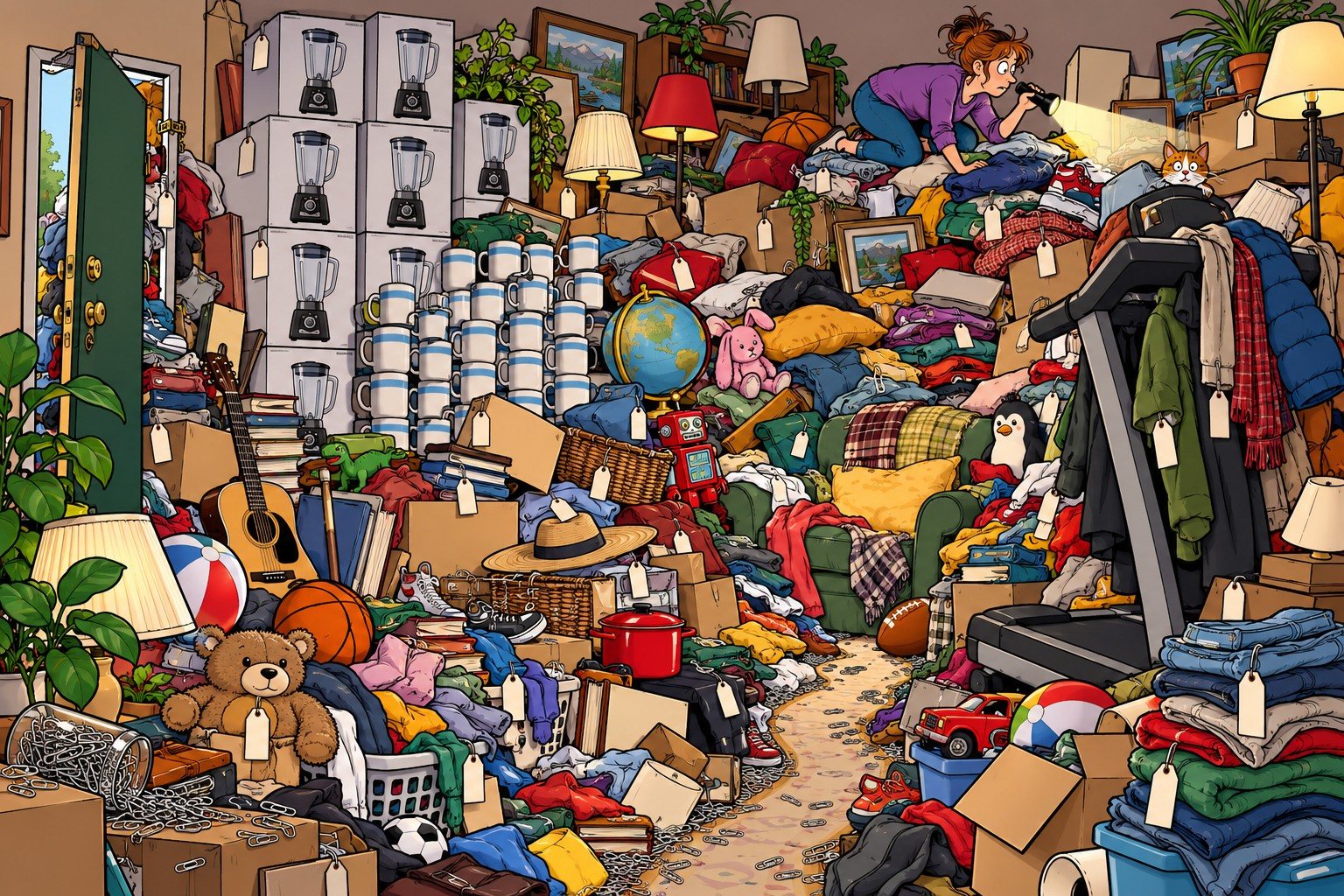
More was never the hard part.
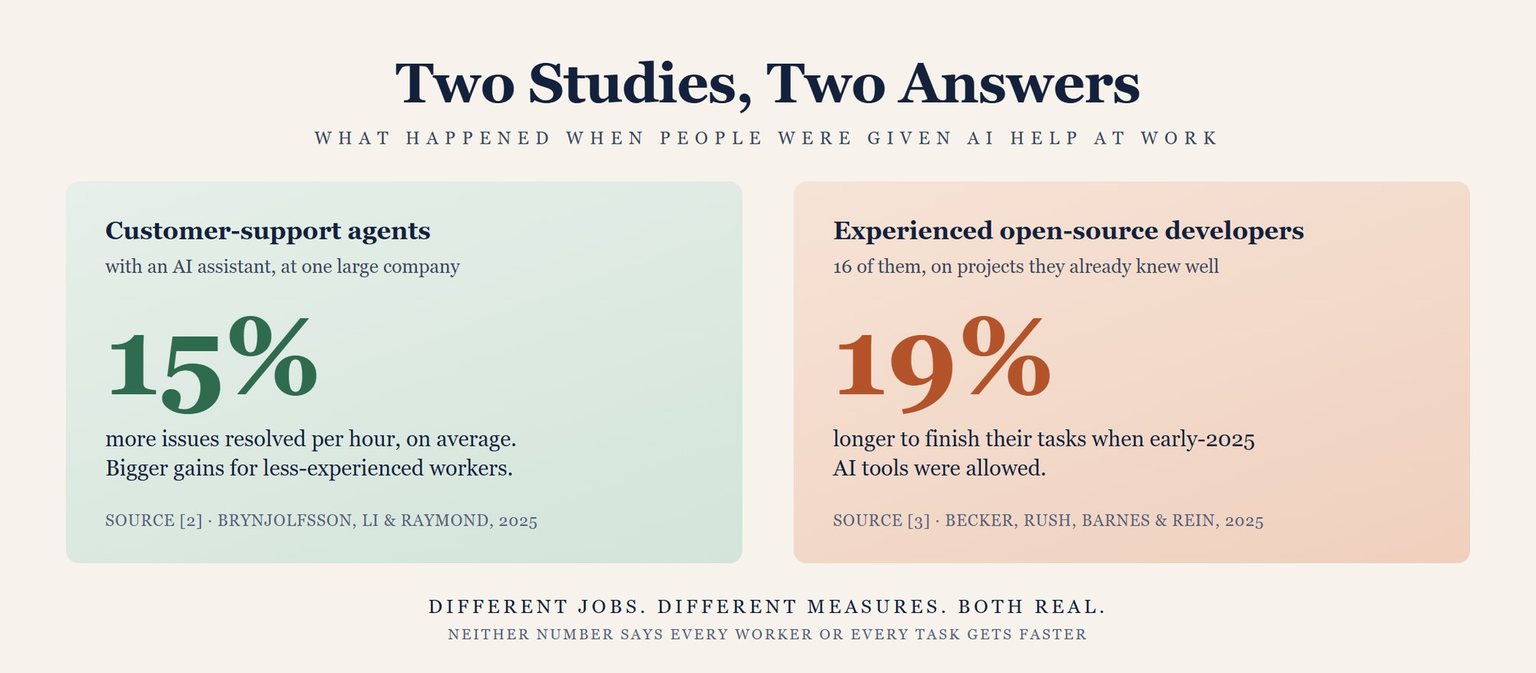
Still, it matters when one kind of cost falls sharply. A service that once required a paid specialist may become available to someone who could never afford the specialist. New tools can distribute abilities that used to sit behind years of training, expensive equipment, and offices with unfortunate carpeting. In a study of customer-support workers, researchers found that access to an AI assistant increased issues resolved per hour by roughly fifteen percent on average, with larger gains for less-experienced workers.[2] That is a real improvement, measured in a specific workplace. It does not mean every worker, or every task, gets fifteen percent faster.
Another study found the opposite. Sixteen experienced open-source developers working on their own mature codebases took nineteen percent longer on assigned tasks when they were allowed to use the early-2025 AI tools in the experiment.[3] I like that result being in the room. The future deserves to be tested without a salesman holding the stopwatch.
Now picture the gains continuing anyway, unevenly, with failures, false starts, and occasional jumps that leave everybody blinking. A business produces more with fewer hours. An individual creates a service that used to require a department. Software gets cheaper to make. What happens to the price, and what happens to the people whose wages came from making it?
Money is not just a punishment for being born into a physical universe. It helps us compare claims on limited resources. Even if an AI can design a thousand beautiful chairs in an afternoon, somebody needs wood, a shop, transportation, a place to store the chairs, and a reason to make one particular design rather than the other 999. If all of that also becomes automated and cheap, some costs shrink further. The question becomes which costs remain, and who controls the gates in front of them.
That is where this cheerful future gets sharp and pointed.
Imagine two people standing in the same abundant world. One owns the systems that produce the goods. The other no longer has a job because those systems do the work. The factory can fill a warehouse. The person outside it still needs a way to obtain what is inside. An economy can become better at creating wealth without automatically becoming better at sharing access to it. Cheaper production is a technical achievement. Distribution is a human arrangement, with rules, power, and people arguing over the rules.
I don't think that observation points to one obvious economic system. There are ideas worth examining: broader ownership of productive assets, public services that are free at the point of use, direct income support, new forms of cooperative business, taxes and dividends tied to the gains from automation. Each raises questions about incentives, cost, control, and who gets to decide. I am suspicious of anybody who can repair the whole future with one slogan and a payment link.
The International Labour Organization's 2025 assessment estimated that about one-quarter of global employment sits in occupations with some potential exposure to generative AI.[4] The researchers emphasized transformation rather than wholesale replacement as the more likely outcome for most jobs. Exposure is not a pink slip, and the figures cannot tell us how many people will be working twenty years from now. They do tell us that the relationship between earning and producing deserves attention while we still have the luxury of thinking about it ahead of time.
And people do not enter that transition equally. The International Telecommunication Union estimated that 2.2 billion people remained offline in 2025.[5] The World Bank has documented large gaps between wealthy and poorer countries in access to computing infrastructure, digital skills, and AI development.[6] We can fill the internet with free tools and still fail people who cannot reach them, use them reliably, or understand what they're being asked to agree to.
Then there is the paperwork.
I get impatient with institutions. It sometimes seems possible to build a new digital service over a weekend while the process for changing the rule governing that service still waits to schedule its second meeting about the first. But speed is not the only virtue. Laws protect people who did not consent to become experimental material. Safety inspections, labor rights, and democratic debate are not automatically evidence of stupidity. A society that updates every rule as quickly as the latest software release might be impossible to live in.
The mismatch is real, though. The International Energy Agency estimated in 2025 that building new electricity transmission lines in advanced economies can take four to eight years.[7] AI services still need electricity, and a new model can arrive much faster than a transformer. Some of that delay comes from approvals; some from equipment, engineering, construction, and the stubborn refusal of physical materials to appear just because a company announced a deadline. Bureaucracy is part of the question, but it is not the whole bottleneck.
So perhaps we need institutions that can learn without improvising away people's rights. Rules that can be evaluated against actual outcomes. Ways to test new systems under limits, expose failures, correct harm, and make access less dependent on being wealthy enough to survive the testing phase. I don't know the full design. I would like us to start arguing about it before the machines have finished arguing among themselves.
One more problem follows us out of economics into the part of a human being no spreadsheet can fully account for.
If machines eventually produce much of what keeps us alive, what becomes of the person who always introduced himself by his work? I have spent enough hours at a seafood counter to know that earning a living can give a day structure, and enough hours creating after work to know that structure isn't the same as purpose. I know what I would like to do with more freedom. I would like to build things that help people who have less. The practical problem is getting help into their hands while keeping my own lights on. Good intentions have operating expenses. So do websites. Apparently, even digital immortality has a renewal date.
We might eventually be free to choose our challenges rather than inherit them from the price of surviving. That sounds wonderful to me. I also suspect we would have to learn how to handle that freedom. Desire has never shown much interest in retiring just because the cupboard is full. There will still be people to love, art to make, differences to reconcile, knowledge to chase, and the question of what any of us are doing here. The answer may be more interesting once rent stops interrupting it. I am not counting on rent being that considerate anytime soon.
I can build Osario, put the files in a package, and offer to let somebody try it. Then the questions begin. Can they install it? Is their data safe? Will the assistant behave responsibly with their files? Can they afford to run it? Who answers when it breaks? The software exists. Making it genuinely available is still work.
That may be the first price of infinite: every time we make creating easier, we expose the parts of sharing that were difficult all along.
The sphere is still turning on my screen. The lines keep crossing. The machine can suggest another thousand things I could make before breakfast. I am looking at the distance between this desk and the person who might actually need one of them.
From the Books
A Flame With Instructions
The Match: A Grimoire of Real Spells, Old Ways, and Alchemy
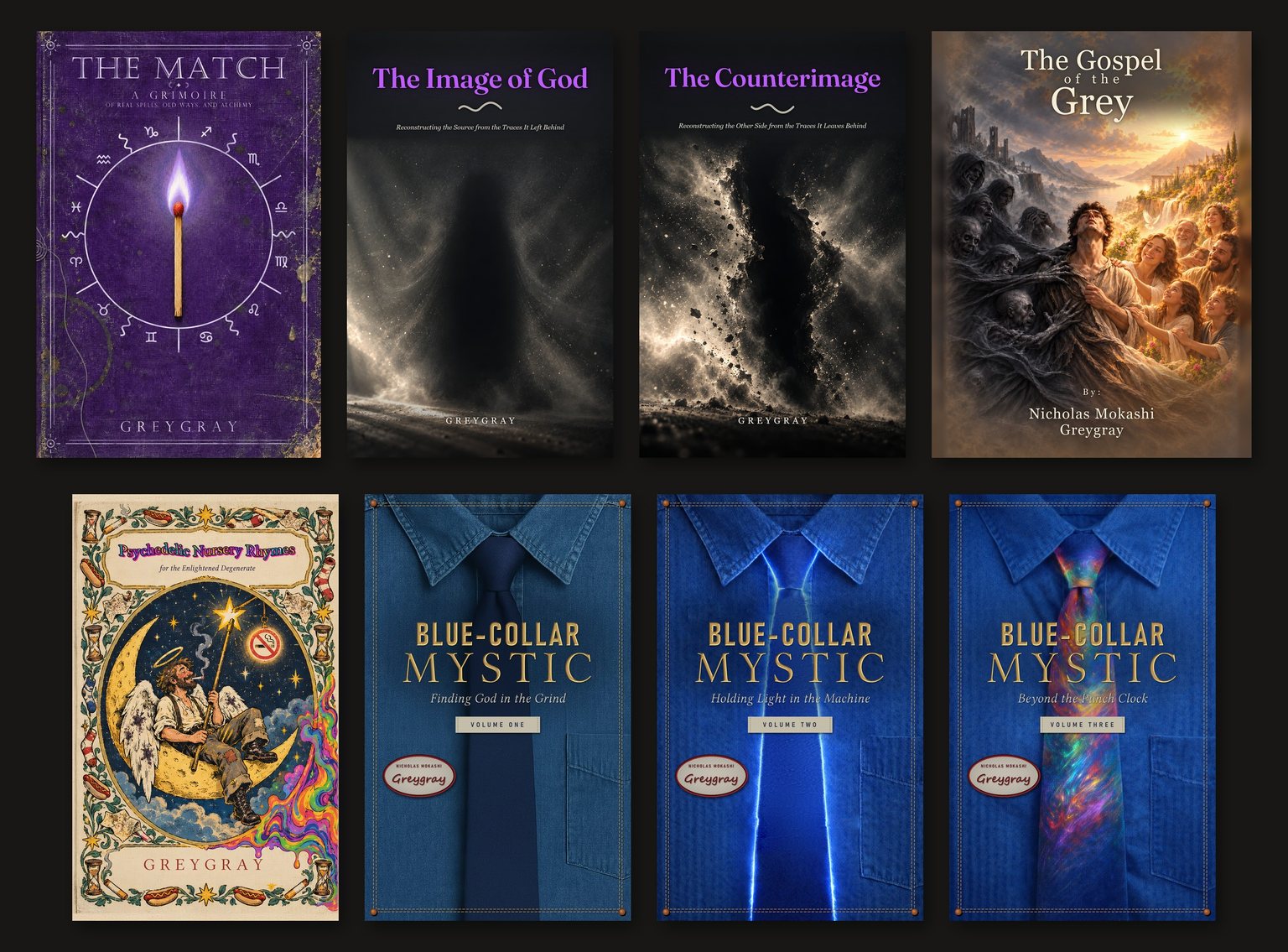
If I've been somewhat quiet on Substack lately, the picture above is mostly why. I've been working on all of it, plus the house to keep it in.
The newest book on my shelf is The Match: A Grimoire of Real Spells, Old Ways, and Alchemy. It's available to buy now. The name has two possibilities built into it. One match can light a candle so somebody can find their way through the dark. It can also burn the whole damn house down. The flame doesn't care which job you gave it.
I wanted a grimoire that would look for the practices people actually used, the histories attached to them, and the gap between what the ritual promised and what anyone can responsibly claim happened. Old spells, old ways, material transformations, and the persistent human urge to change the conditions of a life. If a practice comes from a source, the reader deserves to know which one. Mystery does not need counterfeit history to be interesting.
You can buy The Match on Amazon, or find it with the rest of my books in the Study.
But there is another option. I've hidden a free digital edition somewhere inside The Grey Strand. Not a trial chapter. An ebook. I am not telling you which room to search. The house has doors for a reason.
Buy the book, find the book, or just enjoy the hunt. You're welcome either way.
The Napkin
A Public Artifact of Me
Opening The Grey Strand has been the strangest part of this month. I spent years making things that lived in separate files and tabs: books, essays, games, experiments, sketches, questions that turned into three more questions, and projects that changed names halfway through the afternoon. Then I made a house for them. I gave them rooms. A person could enter through the front door and wander around without needing me to explain what every object was doing there.
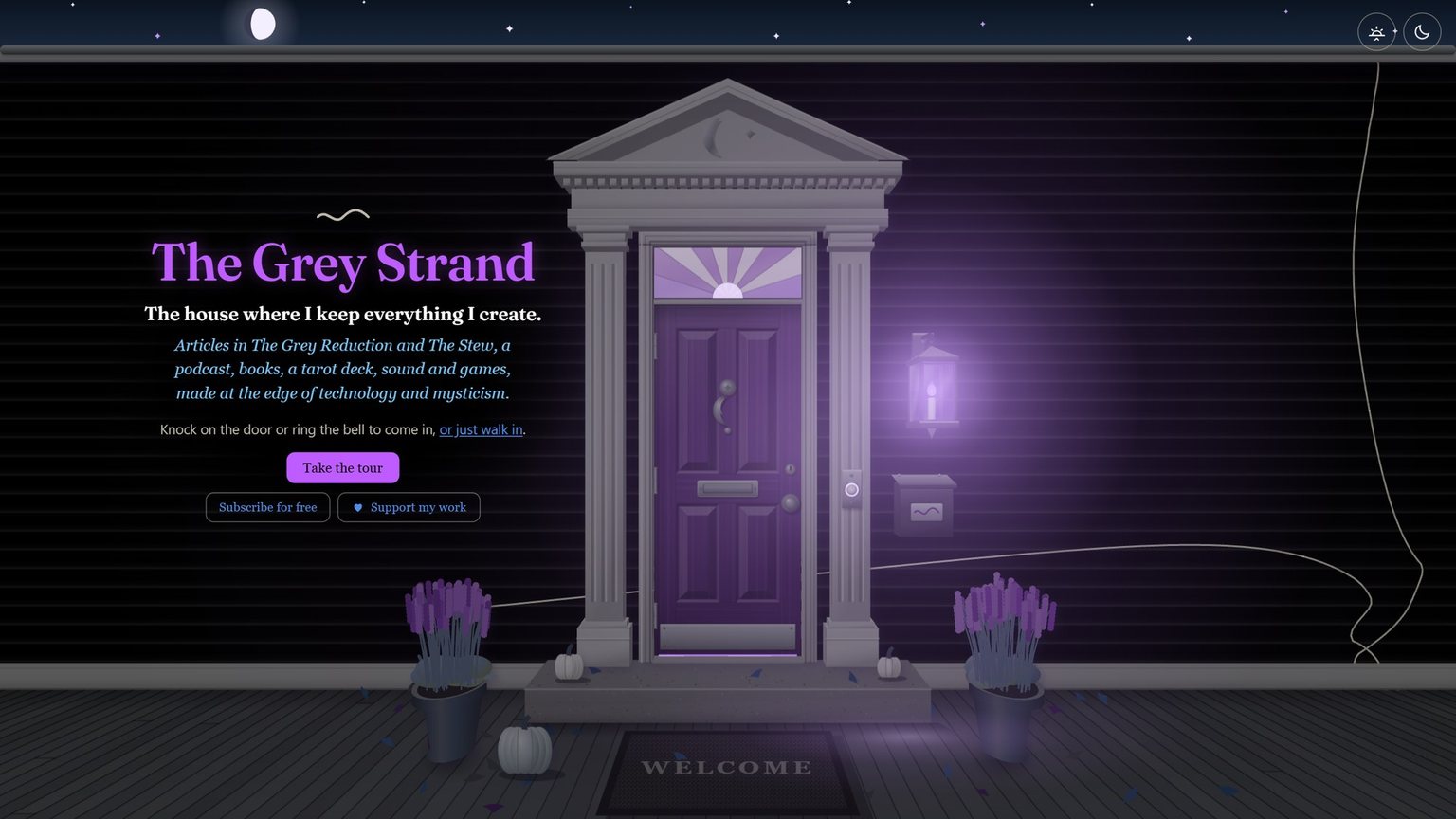
I expected to feel relieved when it finally opened. Mostly, I felt exposed in a way I had not anticipated. Anybody can wander through the house and find the way my brain organizes its interests. The soundtrack plays. The rooms have different moods. The books sit beside the games, and the experiments are allowed to be experiments. There are traces of my unfinished thinking mixed in with work that has already gone out into the world. It turns out a website can become a public artifact of the person who keeps rearranging it.
I wondered what somebody might make of it fifty years from now, assuming the links still worked and the world still had browsers, or whatever replaced them. They would probably find plenty to disagree with. Good. I have disagreed with myself often enough.
What I would want them to know is much simpler: I enjoyed the ride.
And while I'm here, the place is not a monument. Come explore it. Tell me which room you like. Tell me what belongs in the next one. A house gets better when people actually visit.
The Recipe
No Way to Carry It
What you get when you throw away the container is not freedom from the thing the container was holding. You get the thing with no way to carry it.
Greygray, Meditations with the Mirror: Conversations on God and Consciousness Using Artificial Intelligence
Tip The Kitchen
Same Bowl. Same Table.
The Stew is free, and it stays free. So are the articles and the doors to the ordinary rooms in this house. I like that people can show up hungry without being asked for a receipt first.
If this place gives you anything worth keeping, a paid subscription or a one-time tip helps pay the expenses that technology has not yet made imaginary. If money is tight, come in anyway. I would rather have a real conversation than another locked door.
Same bowl. Same table.
Other Recipes
Keynes Asked First
In 1930, John Maynard Keynes wrote Economic Possibilities for Our Grandchildren, imagining that rising productivity might eventually leave people working fifteen-hour weeks.[8] He also understood that a life less governed by economic necessity would present its own problems. He was describing a possible future, not announcing an appointment time.
For a more recent set of uncomfortable numbers, the ILO's report on which jobs AI might transform is worth your time. And if the machinery itself has you curious, The Machinery of Becoming is an earlier bowl about where instruction, learning, and biology begin to blur.
What's Simmering
Too Many Things on the Stove, Apparently
Osario, the assistant behind The Living Sphere, is the project I most want other curious people to try next. The sphere is a layered three-dimensional way to explore memory, reasoning, connections, predictions, uncertainty, and the way ideas relate to one another. It is visually ridiculous in the best sense. Underneath it is actual software with knowledge tools and voice features, not just a moving screensaver pretending to have achieved enlightenment.
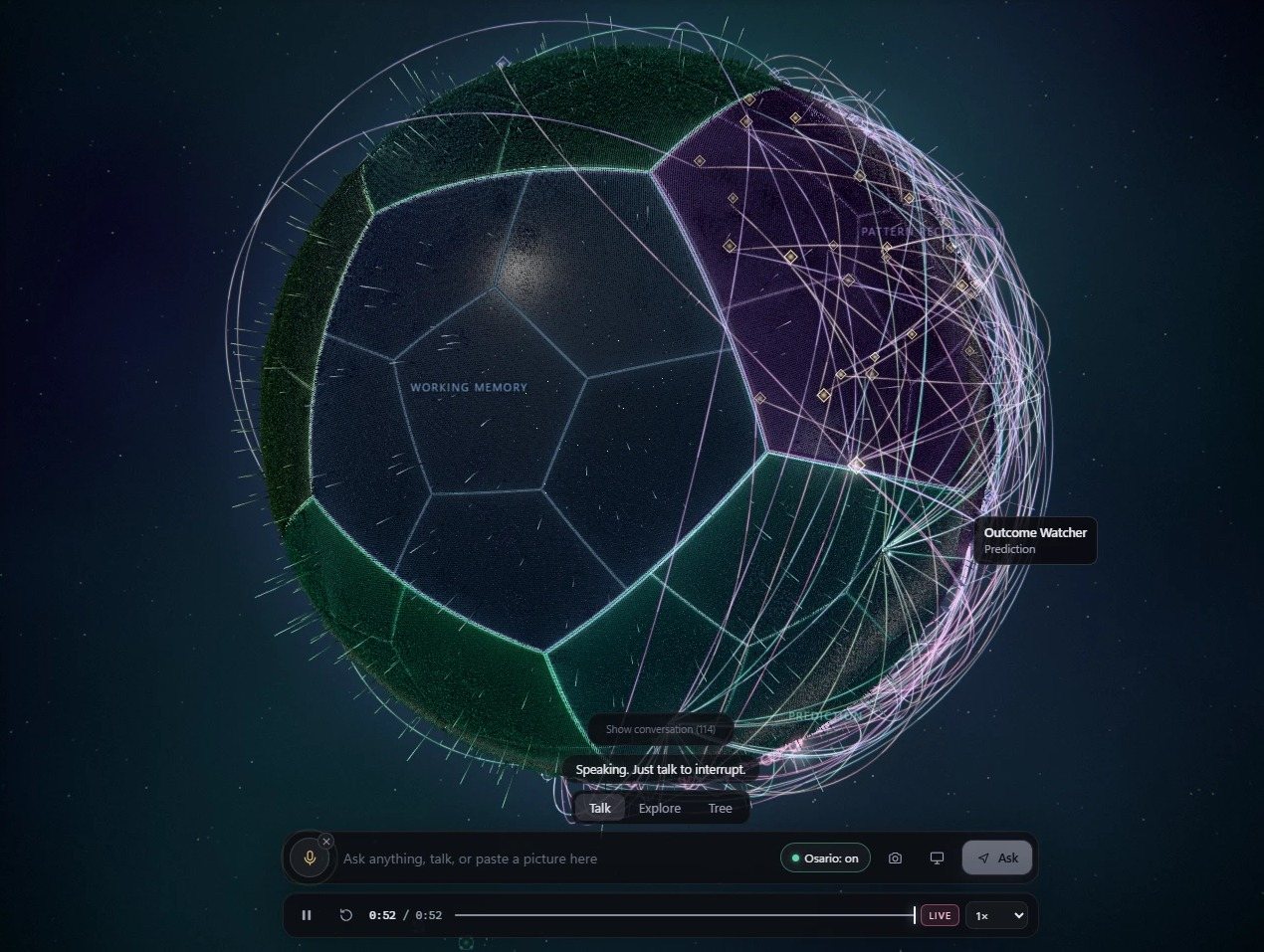
It is still experimental. The next job is the boring but important one: getting it to behave reliably on computers that are not mine, making installation understandable, and checking its privacy and permission controls under real conditions. A controlled personal trial makes sense before any public release. If you want to ask about trying it, write to [email protected]. We'll talk about whether your setup is suitable, rather than promising a magic download that will definitely work every day.
Serving Seconds is still the voice side of this house, where ideas have to survive coming out of my mouth instead of sitting patiently in a document. I have been refining the microphone, mixer, recording, and sound-effects setup. New music work is going on, too, and I am gradually learning the difference between a collection of buttons and a usable musical instrument.
The Gospel of the Grey is still being built. Psychedelic Nursery Rhymes for the Enlightened Degenerate has been redone and reformatted with new art, and it's shaping up to be exactly the sort of book that would make a librarian request a transfer.
And yes, the software experiments keep multiplying. I am trying to give each one enough attention to become useful instead of collecting prototypes like souvenir spoons. The challenge is deciding which burners get heat, not pretending there is an infinite stove.
The Cake
Decide What Enough Is
Look around the room you're in. Find one thing you have more of than you will ever use, and one person who could use it. That is the price of infinite, at a size you can pay tonight.
If you find a way to make dinner for everybody, invite me. I'll help with the dishes.
The Grey Strand · The Grey Reduction · The Stew · My Books
Take what’s useful. Leave what isn’t.
The Grey Strand · As above, so below.
Sources
- Bostrom, Nick. 2003. "Ethical Issues in Advanced Artificial Intelligence." In Cognitive, Emotive and Ethical Aspects of Decision Making in Humans and in Artificial Intelligence, Vol. 2, ed. I. Smit et al., 12-17. International Institute of Advanced Studies in Systems Research and Cybernetics. nickbostrom.com/ethics/ai
- Brynjolfsson, Erik, Danielle Li, and Lindsey R. Raymond. 2025. "Generative AI at Work." The Quarterly Journal of Economics 140(2): 889-942. www.gsb.stanford.edu/faculty-research/publications/generative-ai-work
- Becker, Joel, Nate Rush, Elizabeth Barnes, and David Rein. 2025. "Measuring the Impact of Early-2025 AI on Experienced Open-Source Developer Productivity." arXiv 2507.09089. arxiv.org/abs/2507.09089
- Gmyrek, Paweł, et al. 2025. "Generative AI and Jobs: A Refined Global Index of Occupational Exposure." International Labour Organization, Working Paper 140. www.ilo.org/publications/generative-ai-and-jobs-refined-global-index-occupational-exposure
- International Telecommunication Union. 2025. Facts and Figures 2025. www.itu.int/itu-d/reports/statistics/facts-figures-2025
- World Bank. 2025. Digital Progress and Trends Report 2025: Strengthening AI Foundations. www.worldbank.org/en/publication/dptr2025-ai-foundations/report
- International Energy Agency. 2025. Energy and AI, Executive Summary. www.iea.org/reports/energy-and-ai/executive-summary
- Keynes, John Maynard. 1930. "Economic Possibilities for Our Grandchildren." The Nation and Athenaeum, October 11 and 18, 1930. Text reproduced by the Economics Network. www.economicsnetwork.ac.uk/archive/keynes_persuasion/Economic_Possibilities_for_our_Grandchildren.htm