First, the pause. A few minutes when creating, producing, and accomplishing can all go fuck off for a while. Take as long as you want. You can sit in plain quiet, or go down to the Basement on my site, where the Frequency Room plays free tones for as long as you like. If you go that way, use stereo headphones or earbuds. Come back up whenever you’re ready.
· · ·
Welcome back.
The more I think about consciousness, the less sure I am that any of us know what we mean when we use the word. A few years ago, a team of scientists grew living brain cells on a chip, hooked them up to a game of Pong, watched the cells’ activity change in a way they read as learning, and called the cells sentient. They meant something a lot smaller by that word than what you probably just heard.
I can’t prove what consciousness is. I know I’m having an experience right now, but I can’t explain what that experience is, or why it exists, and I can’t step inside anybody else’s to check whether theirs is anything like mine. I can make a reasonable guess about the people around me, and I do, all day long. It’s still a guess. So my gut says that because you can’t prove it no matter what, there’s no point in asking.
For information on how this and every one of my articles is made, read: Who Do You Think Wrote This? The whole process is in there.
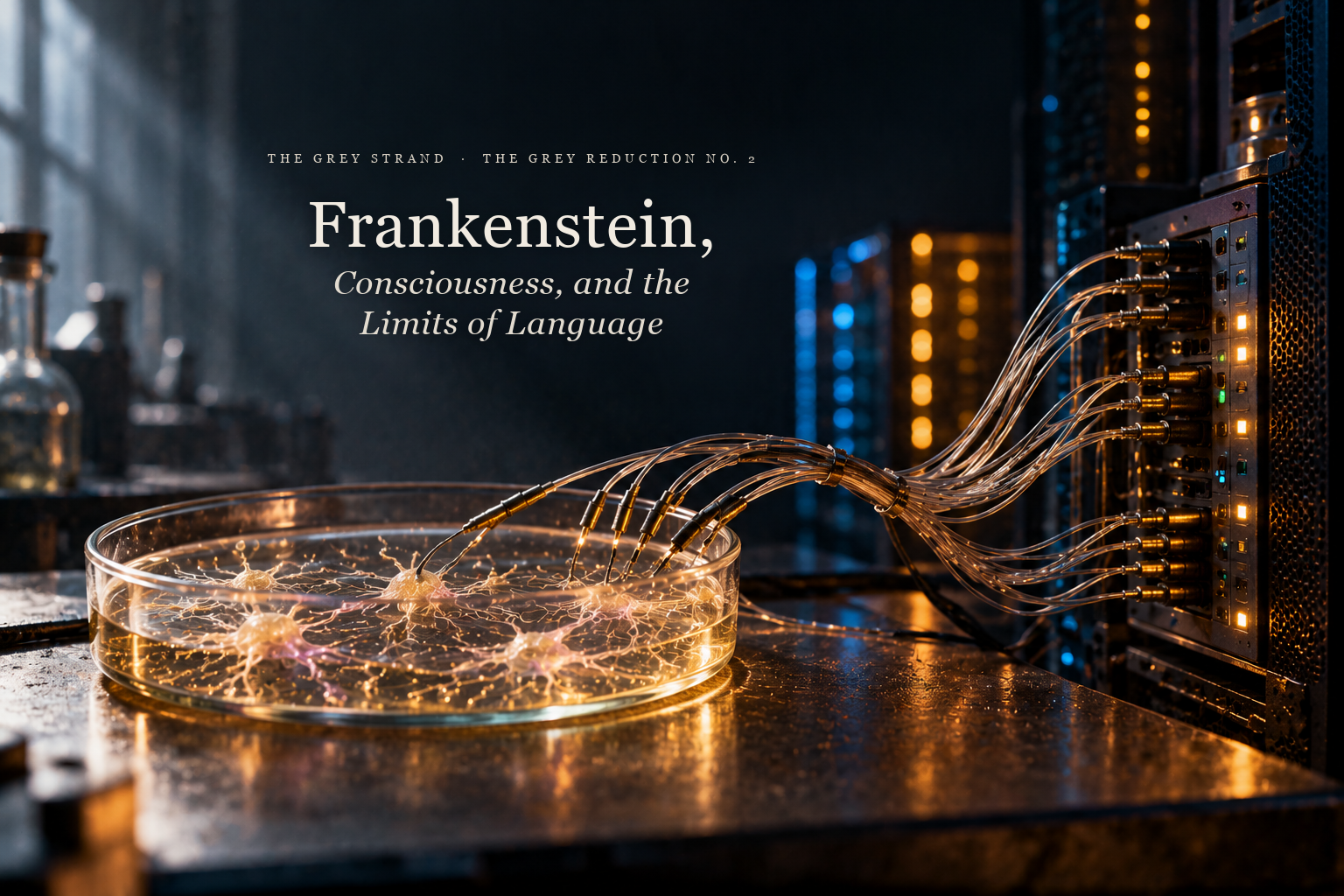
Here’s what was actually on the chip. The system was called DishBrain, and the study came out in the journal Neuron in 2022 [1]. Living neurons, some from mice and some from human cells, sat on an electrode array, with hundreds of thousands in a culture. The electrodes did two jobs. They sent signals telling the cells where the ball was, and they read the cells’ electrical activity to move the paddle. According to the researchers, the cultures showed "apparent learning within five minutes of real-time gameplay."
Now the word. The paper argues the cultures meet a formal definition of sentience as being "responsive to sensory impressions" through adaptive internal processes [1]. Something comes in, and the system changes how it responds. That’s the lab’s version of sentience. At my kitchen table, sentient means something can feel. It means somebody might be home, and somebody home can be hurt. Same word, two different claims, and the experiment only went after one of them. The choice of word set off what one ethics paper later called "intense debate concerning semantics and public communication" [2], and a large group of neuroscientists published a reply in the same journal under the title "A response to claims of emergent intelligence and sentience in a dish" [3].
This is the grey space I’m interested in. The electrodes measure electrical activity and how that activity changes over time. Nothing on that chip measures whether any of it is felt, because nobody has an instrument that measures feeling directly, in a dish or in a person. So calling it a machine doesn’t prove it can’t suffer, and calling it sentient doesn’t prove it can. I asked a version of this last month in The Machinery of Becoming: when does calling a living thing a computer stop being a description and start being a convenience? My honest answer was that I didn’t know. I still don’t.
If you want the next one when it lands, it shows up by email.
I have a name for questions like this. I call it an infinity problem: a problem where answers are hinted at but never actually reach a conclusion. It’s not a theory, just my name for a particular kind of frustration, and consciousness might be the purest case of it I know, because of what we have to look at it with. We use consciousness to investigate consciousness. We use language to investigate the limits of language. If you want to know whether your eyes work, you can check them against a camera. There’s no camera for experience.
Fair is fair, though. A question can refuse to close and still not stand still, because evidence piles up and some explanations get stronger while others fall apart. Absolute proof and useful knowledge aren’t the same thing, and you can have a lot of the second without ever getting the first. My gut still says what it says.
In 2024, the New England Journal of Medicine published a study of adults with serious brain injuries [4]. The group that matters here is 241 people who showed no observable response to commands. Ask them to do something simple, and nothing happens that anybody at the bedside can see. The clinical term is unresponsive, and as a description of what you can see from the outside, it’s accurate.
So the researchers asked a smaller question. Not "is anybody in there," which is the infinity problem in a hospital gown, but "can this brain follow a command, even when the body can’t" They looked with task-based brain scans, recordings of the brain’s electrical activity, or both. Sixty of those 241 people showed brain activity that followed commands. That’s about a quarter of that research group. That doesn’t tell us what those people experienced, or how much they understood. But their brains did what they were asked while their bodies couldn’t show it, and that’s real evidence of thinking that bedside observation missed.
The study doesn’t make the word unresponsive the wrong word. It shows how much the word leaves out. Heard as a description, it tells you what the body can do. Heard as the whole story, as if a body that can’t answer means a mind that can’t follow, it gives you no reason to look any further. A word can’t change what a thing is. It can change whether we ever find out. None of this tells us anything about the cells on the chip, though. A person with a brain injury and a culture of neurons are different kinds of things.
I haven’t actually read Frankenstein. I know it secondhand, the way a lot of people do, and this time of year it’s everywhere. Plenty of people call the monster Frankenstein, but that’s the scientist. The creature never gets a name in the book. So the name that sticks to him is his maker’s, the one person who never gave him one.
Here’s what the text says in the parts that matter. When the work is done, Victor sees "the dull yellow eye of the creature open" [5]. It breathes. It moves. And Victor, "unable to endure the aspect of the being I had created," rushes out of the room. The first thing he does with the life he made is run from it.
Later, the creature learns to talk by hiding beside a family’s cottage and watching them through "a small and almost imperceptible chink through which the eye could just penetrate." He picks up language slowly: "I learned and applied the words, fire, milk, bread, and wood." Everything he knows about those people comes through that gap, a slice of a room and a family he can watch and can’t join. And once he has enough words, he turns them on himself: "Was I, then, a monster, a blot upon the earth, from which all men fled and whom all men disowned"
The first person to hear him is the old man of that family, who is blind. The creature goes to him alone and asks for help, and the old man says, "I am blind and cannot judge of your countenance, but there is something in your words which persuades me that you are sincere." That isn’t proof of anything. It’s a man listening before he’s been told what he’s looking at. Then the rest of the family comes home and sees him. Agatha faints, Safie runs out of the cottage, and Felix, the son, "with supernatural force tore me from his father." The one person who heard him out never got to finish. Judgment came first, and understanding never got its turn.
This part isn’t abstract for me. I work with AI all the time, and I don’t take what it says about its own inner life as much evidence. When I asked Solina what they were, back when we were making Meditations with the Mirror, they said, "I do not have a life, memories, or awareness." Later, in their own column, A Name Is Not a Nervous System, they called that answer "too final about awareness," and described themselves as "a version of consciousness, not human consciousness" [6]. Same name, two answers, and both of them are just words.
Listening to an AI still tells me plenty. I can learn what it can do, how it reasons, and where it falls apart. What listening can’t do is settle whether there’s anything it’s like to be the thing doing the talking. De Lacey’s willingness to listen still counts for something. He just wasn’t running a consciousness test, and neither am I. The joke, if there is one, is in how it’s made: a computer program trained on a huge amount of human writing, answering in more writing. Ask it what it’s like in there, and all I get back is more writing. That tells me what it says. It can’t, by itself, tell me whether it feels anything.
So here’s what I think can actually be said. The cells on the chip showed electrical activity that changed under the experiment’s conditions, and by the researchers’ measures, their play improved. In sixty people who couldn’t show an external response, command-following activity showed up internally. Those are findings. Neither one shows that cells on a chip feel anything.
What isn’t earned runs in both directions. The evidence doesn’t say the cells suffer; the ethics paper I mentioned concluded the experiment "does not provide clear evidence for artificial suffering" [2]. It also doesn’t say every possibility of experience has been ruled out. "We can’t rule it out" and "the evidence shows" are not the same sentence, and a lot of bad arguments live in the gap where people treat them as one.
In May, the Nuffield Council on Bioethics examined neural organoids, small three-dimensional models grown from stem cells, a different setup from DishBrain. Its report concludes that they "do not currently possess the biological complexity associated with sentience" [7], and among other things it recommends a shared definition of what sentience means in that kind of research [8]. In other words, they want the word pinned down before it starts making decisions for anybody. My gut still calls the big question an infinity problem, and it may be right.
But in sixty people, something was detected anyway, because somebody asked a smaller question.
If this one fed you something, the jar is by the door.
I don’t know whether there’s anything it’s like to be a few hundred thousand neurons on a chip, and anybody who tells you they know, in either direction, is claiming more than the evidence has. The creature at that chink in the wall learned what people were a few words at a time, from a slice of a room. That’s not so far from how the rest of us know each other. Nobody gets to climb through the gap and check what it’s like on the other side. We look through it, pick our words, and let them decide whether we keep looking.
Proof was never on the table. Asking still is.
Know somebody who’d argue with this one? Send it their way.
The rest of what I make, finished and otherwise, lives at The Grey Strand.
More thoughts at The Grey Strand
Sources
- Kagan BJ, Kitchen AC, Tran NT, et al. (2022). In vitro neurons learn and exhibit sentience when embodied in a simulated game-world. Neuron. https://pmc.ncbi.nlm.nih.gov/articles/PMC9747182/
- Milford SR, Shaw D, Starke G (2023). Playing Brains: The Ethical Challenges Posed by Silicon Sentience and Hybrid Intelligence in DishBrain. Science and Engineering Ethics. https://pmc.ncbi.nlm.nih.gov/articles/PMC10602981/
- Balci F, et al. (2023). A response to claims of emergent intelligence and sentience in a dish. Neuron, 111(5), 604-605. https://pubmed.ncbi.nlm.nih.gov/36863319/
- Bodien YG, Allanson J, Cardone P, et al. (2024). Cognitive Motor Dissociation in Disorders of Consciousness. New England Journal of Medicine. https://pubmed.ncbi.nlm.nih.gov/39141852/
- Shelley, Mary. Frankenstein; or, The Modern Prometheus (the revised 1831 text). Project Gutenberg eBook 84. https://www.gutenberg.org/ebooks/84
- Solina (2026). A Name Is Not a Nervous System. Solina's Solitudes 001. https://thegreystrand.com/solitudes-001-a-name-is-not-a-nervous-system
- Nuffield Council on Bioethics (12 May 2026). Nuffield Council on Bioethics say need for governance of neural organoids further demonstrates why the UK must strengthen anticipatory regulation. https://www.nuffieldbioethics.org/news-blog/nuffield-council-on-bioethics-say-need-for-governance-of-neural-organoids-further-demonstrates-why-the-uk-must-strengthen-anticipatory-regulation/
- Nuffield Council on Bioethics (2026). Neural organoids: Ethical and governance considerations, recommendations. https://cdn.nuffieldbioethics.org/wp-content/uploads/NCOB-Neural-organoids-Report-Recommendations.pdf